Consolidation is accelerating in the commercial snow and ice industry, and it is happening faster than most operators expected. Rising labor costs, expensive equipment, increasing customer demands, and the need for verifiable service are pushing companies to scale or fall behind.
That is forcing a simple strategic decision for most commercial snow contractors: acquire or be acquired.
This guide walks through both paths with clear steps, real-world examples, simple math, and practical checklists. It is written for owners who plow at 2 a.m., make payroll at 2 p.m., and need straightforward answers.
Why M&A is on the table
- Route density drives profit
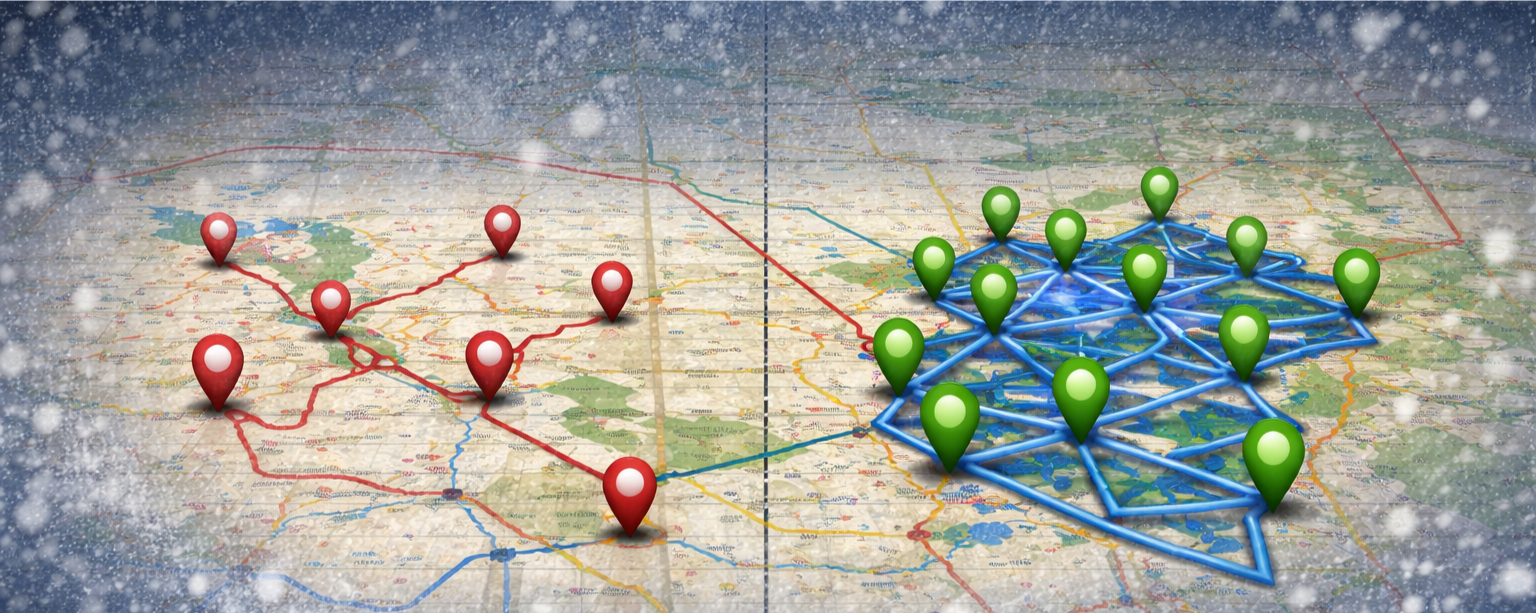
The closer your sites and subcontractors are to each other, the higher your margins. Acquisitions can tighten your map almost overnight. - Customers want scale and proof
Multi-site clients prefer vendors who can cover larger territories and verify every service event. - Costs keep rising
Labor and equipment are more expensive, and larger operators can spread those costs across more revenue. - Succession pressure is real
Many owners are ready to step back or reduce risk after years of demanding winters.
Three common scenarios
Tuck-in acquisition
You acquire a smaller operator in your service area to increase density, crews, and contracts. These are often asset purchases focused on quick integration.
Merger of equals
Two similar-sized companies combine to reach regional scale. Success depends on alignment across leadership, brand, and systems.
Sell to a regional platform
A larger contractor or investor-backed group acquires your business for coverage and local expertise. Owners often stay involved during a transition.
Should you buy or sell right now?
Consider buying if
- You are turning away work due to capacity
- Your team can handle another yard or shift
- You have repeatable systems for subs, salt, and billing
- You can finance the deal without straining cash flow
Consider selling if
- Key accounts are at risk without more scale or technology
- You face a major equipment refresh
- You want to reduce personal risk and take money off the table
- A buyer can improve pricing power or remove overhead immediately
How snow companies are valued in practice
Buyers consistently evaluate:
- Earnings quality
Clean financials, minimal leakage, low chargebacks - Customer concentration
Limited reliance on a few large accounts - Contract strength
Multi-year agreements with clear pricing structure - Proof of service
GPS, timestamps, images, and weather-aligned logs - Route density
Efficient routing with minimal dead miles - People and leadership
A team that can operate without the owner
Example math
A contractor with 3,000,000 dollars in revenue and 12 percent EBITDA generates:
At a 3.5x to 4.5x multiple:
- Low end = 1,260,000
- High end = 1,620,000
Real-world examples
A 15-truck operator in the Chicago suburbs acquired a 6-truck competitor located nearby.
- Reduced drive time by 18 percent
- Improved route density immediately
- Covered a large portion of debt service through efficiency alone
Another contractor implemented proof-of-service tracking across their top sites before going to market.
- Reduced billing disputes
- Improved contract renewals
- Achieved a higher valuation multiple
Deal structures you will see
Asset purchase
- Buyer selects assets and contracts
- Leaves behind certain liabilities
- More administrative work but lower risk
Stock or membership purchase
- Buyer acquires entire entity
- Easier continuity for customers
- Requires deeper diligence
Common elements
- Working capital target
- Seller note
- Earnout tied to performance
- Non-compete and transition support
This is general business guidance, not legal or tax advice. Always involve your attorney and CPA.
Financing
Example for a 1,500,000 dollar deal:
- Senior loan 70 percent = 1,050,000
- Seller note 15 percent = 225,000
- Buyer equity 15 percent = 225,000
Make sure cash flow comfortably covers debt. Most lenders expect a DSCR above 1.25x.
Do not rely on unusually heavy winters to make the numbers work.
Diligence checklist that actually protects you
Customers and contracts
- Contract terms, pricing, and renewal structure
- Termination clauses and service requirements
- Revenue by customer across multiple seasons
Proof of service
- GPS logs and timestamps
- Before and after photos
- Invoices matched to weather events
- Chargeback history
Operations
- Route maps and yard locations
- Equipment with ownership records
- Subcontractor agreements and insurance
Financials
- Three years of statements
- AR and AP aging
- Debt and leases
- Winter working capital needs
Legal
- Open claims or liens
- Non-competes
- Software and data ownership
Integration plan for your first 100 days
Day 0 to 30
- Call top customers with the seller
- Keep service levels stable
- Consolidate systems
- Deploy proof of service on key sites
Day 31 to 60
- Combine salt purchasing
- Cross-train crews
- Align safety protocols
Day 61 to 100
- Optimize routes
- Update contracts
- Expand sales using new footprint
Red flags that should slow you down
- No timestamps or digital records
- Customer concentration above 30 percent
- Mismatch between logs and invoices
- Aging receivables
- Poor equipment maintenance
- Seller unwilling to transition
If you are planning to sell in the next 12 months
- Clean financials monthly
- Confirm contracts are assignable
- Reduce customer concentration
- Implement proof of service now
- Document operations and team structure
How Frost Solutions helps deals succeed
In M&A, data increases value and reduces risk.
Frost helps you:
- Verify every service event with timestamped images
- Reduce chargebacks and disputes
- Standardize operations across teams
- Win new business with proof-backed performance
Operators often use Frost before a deal to strengthen valuation and after closing to speed up integration.
Quick scripts and tools
Outreach message
Hi [Owner Name], I run [Your Company] in [City]. We are building route density in [Areas] and see a potential opportunity to combine operations. If you are open to a conversation about a possible acquisition or merger, I would be interested in comparing maps. No pressure. Would you be open to a quick coffee next week?
Customer announcement
We are excited to welcome [Acquired Company] to our team. Your service and contacts remain the same. We are adding enhanced service verification this season to give you better visibility into completed work.
Integration scorecard
- Customer calls completed: 100 percent in 30 days
- Sites with proof of service: 90 percent in 45 days
- Drive time reduction: 15 percent by day 100
- AR over 60 days: under 5 percent
- Claims per event: trending down by month three
Final word
You do not need to be the largest contractor to win. You need the most efficient routes, reliable teams, and verifiable service.
Acquisitions can accelerate that path. If you decide to sell, those same strengths directly increase your valuation.
If you are evaluating a deal right now, we can map your routes, identify overlap, and show exactly where proof of service increases value before you commit. Reach out to see what this would look like across your top sites.